
07 Mar UV Light
UV light plays a crucial part in the well-being of our feathered companions. While windows are essential and offer daylight and environmental stimulation, they predominantly block UV rays. Where regular exposure to natural daylight is not available, the artificial provision of UV-A and UV-B lighting becomes an important element of bird care. This article shines light on the intricate relationship between UV lighting and avian health and wellbeing, and explains what to consider when purchasing avian lighting solutions.
Benefits of UV light
Birds require UV-A for colour vision activation. Birds, reptiles, and some fish have evolved a 4th cone cell in the eye – a condition known as ‘tetrachromacy.’ This allows them to perceive a far broader spectrum of colours when exposed to UV-A than humans are capable of. It has been suggested that Humans (trichromats = 3 types of cone shaped cells) can perceive around 1 million colours, whereas tetrachromats perceive 100 million colours. Allowing birds to experience the world naturally reduces stress, aids in food selection, and facilitates mate selection.
UV light is significant in the production and absorption of vitamins and minerals, particularly Vitamin D. Vitamin D comes in two forms: D2 (ergocalciferol) is mainly found in plants and is less effective for mineral assimilation, whilst D3 (cholecalciferol) is produced after exposure to natural daylight and naturally available in meat products. D3 is potent and pivotal for the proper functioning of calcium/mineral cycles. Imbalances, such as under-supplying UV-B, disrupt vitamin D3 creation, leading to hypovitaminosis D. Whilst D3 can be introduced by way of liquid supplements, allowing birds to self-regulate their UV intake via artificial UV lighting mitigates risks of oversupply and provides a safe, and effective cycle.
Exposure to the right levels of UV also increases preening and stimulation of the preening gland (uropygial gland), which in itself can produce preformed D3, that is consequently in part ingested while preening. Feather plucking has also been linked to a deficiency in UV exposure, as the removal of feathers allows for greater absorption of light directly through the skin. Implementing full-spectrum+UV-B lighting may therefore help mitigate feather plucking behaviours.
UV lamps
The term “full-spectrum” is widely used but lacks a standardized definition, fostering potential mislabelling and confusion that could jeopardize avian health. While replicating the sun’s spectrum in a single lamp remains a challenge, quality lamps can now accurately produce UV. However, LED lighting does not currently have the technology to replicate anywhere near full spectrum, despite claims their manufacturers may make and therefore ‘standard’ lamps, be they fluorescent or LED have no positive impact on the biological function of birds, other than by helping to set a natural circadian rhythm.
When purchasing Avian lamps, you should be looking for the advertised term of ‘full-spectrum + UVA/B. You should also check that the UV logo in a triangle is clearly displayed – either etched onto the glass or printed on the base of the lamp.
Other things to check for are the lamps’ ability to project the desired quantity of UV at distance (UVI), that the colour of the lamp falls within that of natural daylight and that the ‘Colour Rendering Index’ or ‘CRI’ is above 90. CRI is a useful unit of measure within bird lighting, as it is used to measure how similar an object appears under the lamp to the same object perceived under natural daylight. The higher the CRI, the more ‘natural’ the object (bird) will appear.
It is important to note that the effectiveness of UV lamps declines over time and they should be replaced annually to maintain UV potency.
Access and placement
The current avicultural consensus is that providing full-spectrum+UV-B bird lighting for 10-12 hours daily (considering seasonality for breeding birds) can contributes significantly to their overall well-being.
Birds can absorb UV through their feet, cere and any other bare patches of skin. As such, they actively bask and seek out exposure when preening in open sunlight. Birds will self-regulate their exposure to UV Light, adeptly extracting what they need from light sources and then moving on to play or to forage.
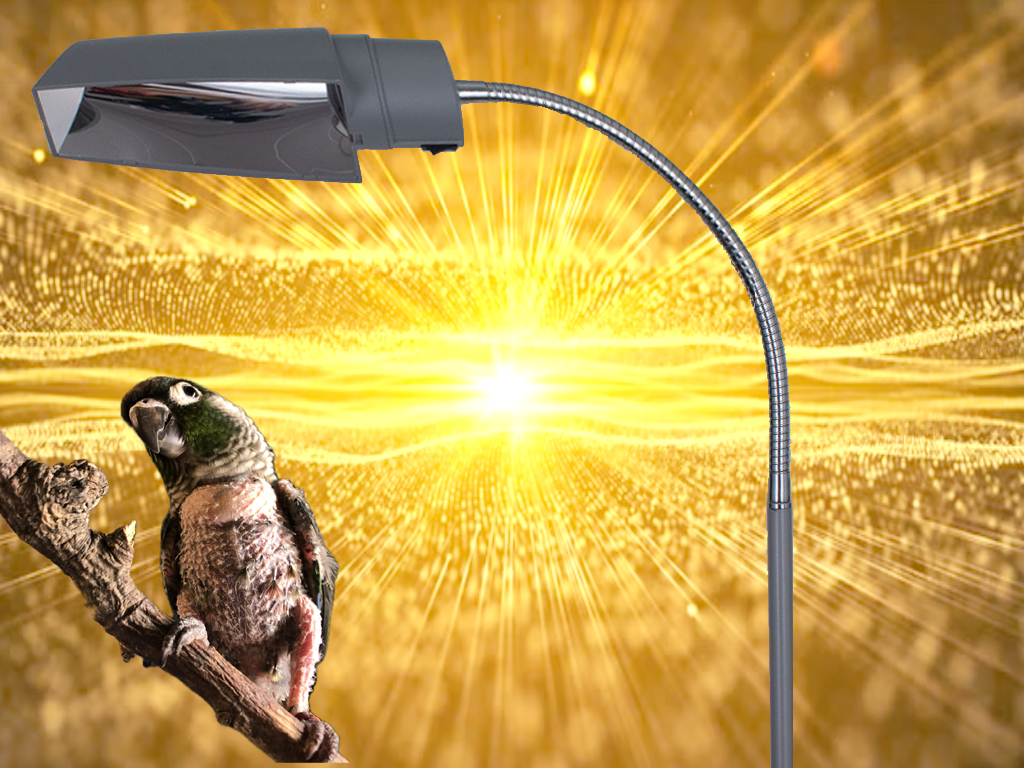
In order to mimic the sun and avoid the hazards of retina or skin burning it is important to place lamps directly above the cage. The top of the cage will receive the most UV exposure and a gradient from high to shade within the cage will be created. The highest perch should be placed an appropriately safe distance from the top (follow manufacturers guidelines). Sufficient absorption will not take place unless the bulb is placed within specified parameters, so placing a lamp in a ceiling light fitting (for instance) is unlikely to be adequate.
Also, please be aware that these are electrical products and care must be taken to ensure cables are shielded from parrot beaks and routed away from bird reach. The lamps are also glass and may become hot when in use, so they should not be accessible to beaks and feet.
You should remove the lamps from their fittings regularly and clean with a soft cloth to maintain effectiveness (ensure light is powered off first).
Purchasing Avian Lighting
In conclusion, unravelling the intricate relationship between UV lighting and avian well-being is pivotal for responsible bird care. By embracing the principles of balanced UV provision, bird enthusiasts can elevate the physical and mental health of their feathered companions, fostering a richer and more natural environment.
The two best known brands of Avian lighting available in the UK are ZooMed’s Avian Sun Lamp (lamp technical data not available) and Arcadia’s range of bird lighting. Arcadia currently provide a larger range of lamps, in a variety of sizes and strengths. Their Pure Sun range provide 2.4% UVB + 12% UVA whilst their other lamps provide 2.4% UVB + 30% UVA.
Information Source: What is light and why it so important? Parts 1 –5